All selected work

Robinhood / AI systems · Creative operations

Scaling creative output without losing the guardrails.

An AI creative dashboard, a custom Figma integration, and automated disclosure insertion for a regulated advertising workflow.

My roleProduct engineer · via Buildroom.ai
ContextClient work · AI creative automation
RobinhoodCREATIVE AUTOMATION
Robinhood Ad System
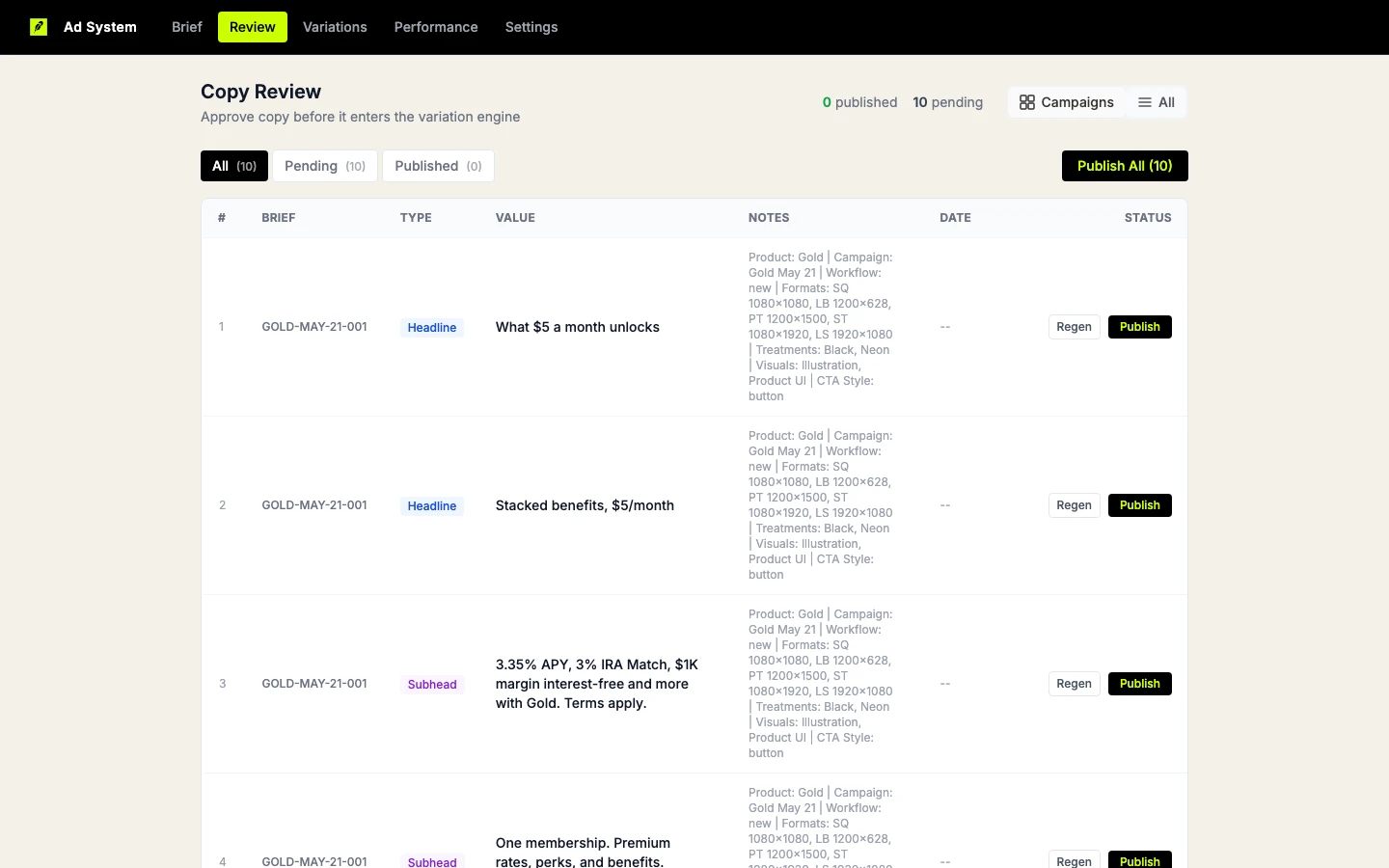
Actual Robinhood Ad System copy review interface
Actual app · captured locally
See the actual app screens

The challenge

The problem to solve.

Turn campaign briefs into ad creative variations with disclosure insertion and human review, and connect generated assets to an internal platform that had no API.

My contribution

What I built and owned.

  • Built an AI dashboard that generates creative variations from campaign briefs using Claude Code, Google Sheets, and Figma.
  • Developed a custom Figma plugin to push generated assets into Robinhood’s internal platform where no API existed.
  • Built disclosure insertion and review support into the ad-copy workflow.

The outcome

What came of it.

My résumé reports a 10× increase in ad output from the workflow, which combines disclosure insertion with human review. The work connected generation with the practical requirements of asset delivery and regulated copy.

10×ad output
CustomFigma integration
Built indisclosure insertion
My ownership

Where I carried the work.

Through Buildroom.ai, I built the creative dashboard, custom Figma integration and disclosure-insertion workflow that connect a campaign brief to reviewable creative.

The wider team & tools

This was client work through Buildroom.ai. The client’s campaign direction, brand assets and approval decisions remain theirs. Generated copy and inserted disclosures still require human review.

How it fits together

The system behind the screen.

  1. 01

    Brief

    Campaign inputs become structured headlines, subheads and calls to action.

  2. 02

    Generate & review

    Claude generation, Google Sheets records and a dashboard for review and feedback.

  3. 03

    Compose in Figma

    Reusable layouts combine copy, brand assets and a dedicated disclosure field.

  4. 04

    Deliver

    A custom integration bridges the final handoff described in the project scope.

The archive contains a Next.js app, server-side model and Sheets integrations, and Figma Plugin API templates. The delivery connection is described in my résumé.

Engineering & product judgment

Decisions that shape the product.

Make review a product surface.

The app has brief intake, review, variation and performance views. Regenerating copy saves feedback and clears its previous approval state.

The tradeoff

Generating a plausible line is only one step. A reviewer needs to understand what changed and make the approval decision.

Keep disclosure text separate from creative text.

Figma templates accept a dedicated disclosure field, so the layout carries that text alongside the headline and visual.

The tradeoff

Insertion is a useful control, but it does not establish legal accuracy or replace the client’s review process.

Batch composition at the integration boundary.

The Figma implementation loads fonts once, caches logo variants, creates multiple layouts in a batch and cleans up temporary assets afterwards.

The tradeoff

Batching reduces repeated setup work. Batch size still needs to fit the host’s execution limits; no new latency benchmark is claimed here.

An iteration from the archive

A correct asset can still land in the wrong place.

The Figma implementation notes describe artwork whose outer frame contained empty space. Scaling that frame did not scale the visible illustration as expected.

The template workflow uses the inner artwork bounds and calculates a placement zone between the text and logo, with padding. Related helpers handle contrast changes for darker backgrounds.

Creative automation needs layout-aware checks as well as correct text. Small integration details decide whether the output is actually usable.

Outcomes, with context

10×

Reported ad output

Résumé-reported workflow result. Baseline volume and measurement period are not included in the source.

4

Template formats

Square, story, portrait and landscape templates verified in the project archive.

Human

Approval responsibility

Disclosure insertion and review tooling support the process; they are not a guarantee of regulatory compliance.

Sources & scope

Ownership and 10× outcome: September 2026 résumé. Workflow, approval reset and batching details: original app and Figma source. Actual app screenshots are available in the related build.

Keep exploring

Showplace

Have something in mind?

Say hello.